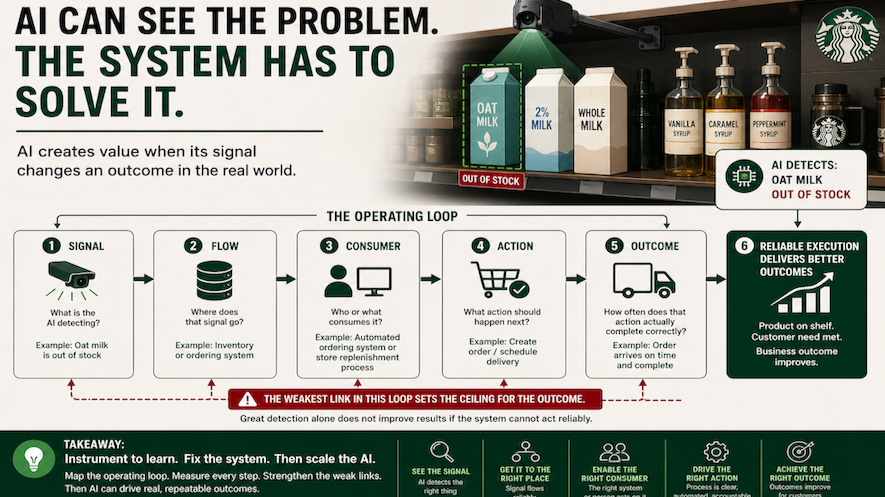
Better inventory sensing creates value only when the operating system can convert that signal into a reliable replenishment or recovery action.
Reuters reported in May 2026 that Starbucks retired an AI-assisted inventory-counting program nine months after deploying it across its North American stores. Reported failures included miscounted or mislabeled products. The architectural lesson is larger than model accuracy: every AI signal participates in an operating loop.
The operating loop matters more than the model
An inventory solution spans at least three layers:
- Sensor: identify products and quantities under real lighting, packaging, placement, and occlusion conditions.
- Integration: reconcile the observation with catalog, inventory, replenishment, and exception state.
- Actuator: create an order, adjust a shipment, route an exception, or prompt an accountable human action.
Improving the sensor does not repair a weak replenishment loop. A precise out-of-stock signal still fails the customer when the supply network cannot respond predictably.
Evaluate the system, not only the classifier
A production evaluation should measure false counts and classifications, but it should also track correction effort, associate time, inventory-record accuracy, replenishment response, product availability, and customer outcomes. Human overrides must become labeled feedback rather than invisible operational work.
This changes the rollout question from “Is the model accurate?” to “Does the complete operating loop improve a business outcome without creating more work or hiding failure?”
Architecture before scale
Before expanding an AI-enabled workflow, architects should verify the taxonomy, integration contracts, exception ownership, human recovery path, observability, and downstream capacity. AI can improve a reliable operating system. It can also expose structural weaknesses faster than the organization can resolve them.
The durable principle is straightforward: instrument the AI to learn, repair the operating loop, and scale only when the system—not merely the model—performs reliably.