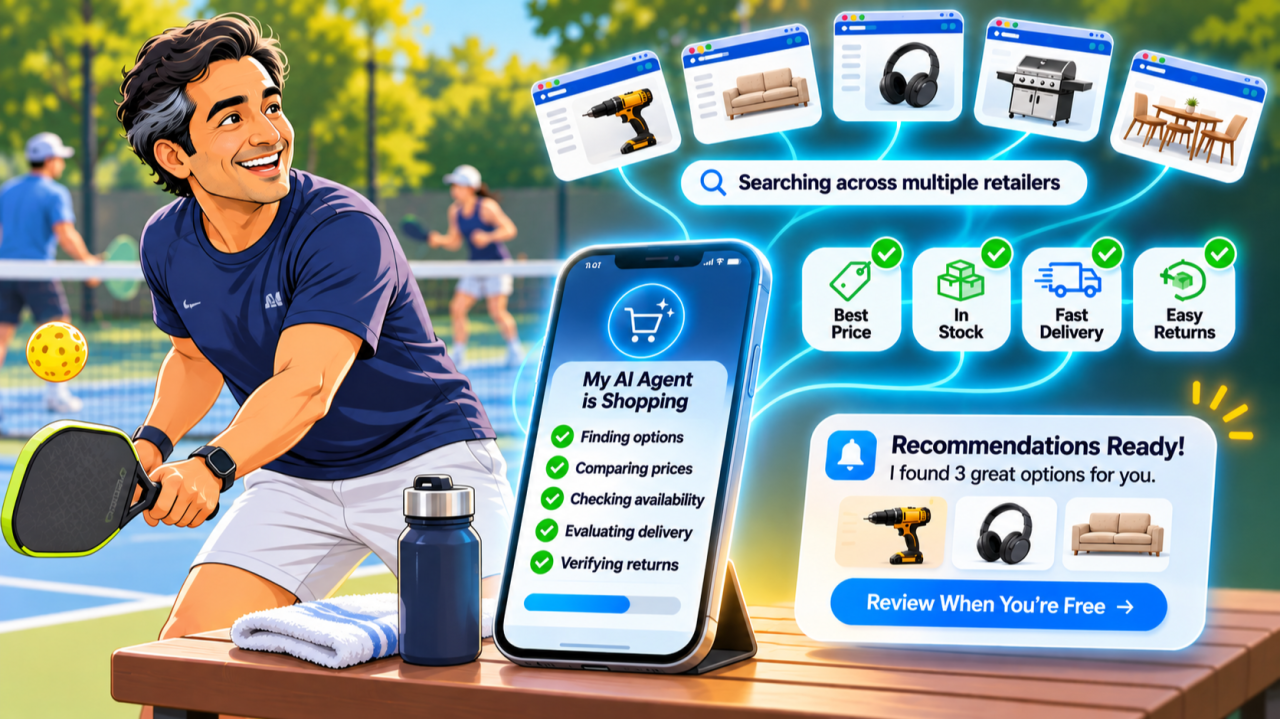
Shopping agents change the beginning of the commerce journey. Before a customer sees a retailer’s experience, an agent may already have decided which products and sellers are credible enough to consider.
I began using personal shopping agents to delegate product discovery and comparison. Reviewing one agent’s activity summary after 38 days showed that it had examined more than 1,200 listings across hundreds of retailer sites. The useful result was not a retailer ranking. It was evidence that an agent’s ability to access and verify commerce data determines which products reach the customer’s consideration set.
The agent decides what enters the consideration set
For many searches, I never opened a retailer’s website. I saw the products the agent could find, understand, and verify. A strong product page was not enough when the agent could not confirm the model, dimensions, compatibility, local availability, delivery date, total price, or return policy.
The human experience still matters: customers need to recognize the retailer, trust the offer, and understand the purchase. But an agent may decide which retailers receive that human attention in the first place.
Agent readiness is a systems property
Agentic commerce is broader than optimizing content for an AI-generated answer. A retailer must make the underlying transaction state dependable enough for software to reason about it. That requires:
- structured, complete product and variant data;
- current location-level inventory;
- transparent total pricing and promotion conditions;
- reliable pickup and delivery promises;
- clear return and cancellation policies; and
- secure, authorized interfaces for consequential actions.
An agent is not merely comparing products. It is comparing the likely outcome of the complete transaction.
Architecture implications
Retailers now serve two related experiences. The human experience creates understanding and trust. The agent experience supplies accessible, current, and verifiable state. Both depend on the same commerce foundation: catalog, inventory, pricing, promise, order capture, payment, fulfillment, and post-purchase operations.
The strategic question is therefore not whether a retailer has a chatbot. It is whether its systems expose enough trustworthy state for an authorized agent to discover, compare, explain, and eventually transact without inventing facts or bypassing policy.